BridgeVFX
The bridge between a vague client note and an artist starting work — an AI pipeline that reads every unactioned note in Flow and paints the answer onto the real frame, for a supervisor to approve in seconds.
The bottleneck
Client feedback is notoriously vague — "warm it up", "make it feel bigger" — and turning that into something an artist can action takes time. Creative intent quietly gets lost in translation.
As supervisors, we own creative cohesion, so every note has to pass through us before it reaches an artist. That's the right call creatively — but with dozens of notes landing daily and supervisors pulled in a dozen directions, it's often the slowest step in the pipeline.
The result: artists sit idle, waiting on a brief that the supervisor simply hasn't had time to write. Bridge was designed from that exact frustration — my artists sometimes couldn't start work because they were waiting on me.
In the tool
The pipeline
Seven AI systems chained together, each doing the one job it's best at. Scroll — the graph executes as you read.
Bridge connects to Flow Production Tracking (ShotGrid) and pulls every unactioned client note, filterable by custom Flow flags.
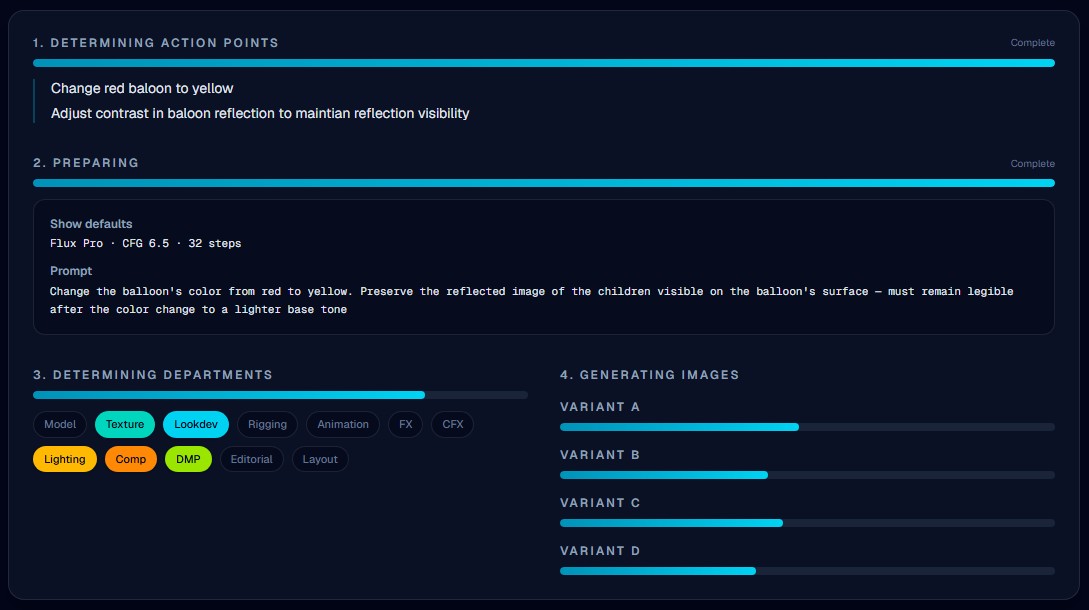
The note is split into discrete action points, each tagged with scope, target and confidence — and whether the edit applies to a specific frame, a range, or any representative frame.
Bridge resolves the file path for the shot and pulls in the exact frame(s) identified in the previous step.
Global grades bypass masking entirely; localised edits are flagged for an object-detection pass. Knowing when to skip a step is part of the design.
For localised edits, Grounding DINO locates the relevant object or region in the frame from plain language and returns a bounding box.
The bounding box is refined into a pixel-precise mask — defining exactly where the edit will apply, and protecting everything else.
Action points, the show's style prompt, and the masked region are combined into a structured inpaint prompt — so every generation stays on-brand for the show.
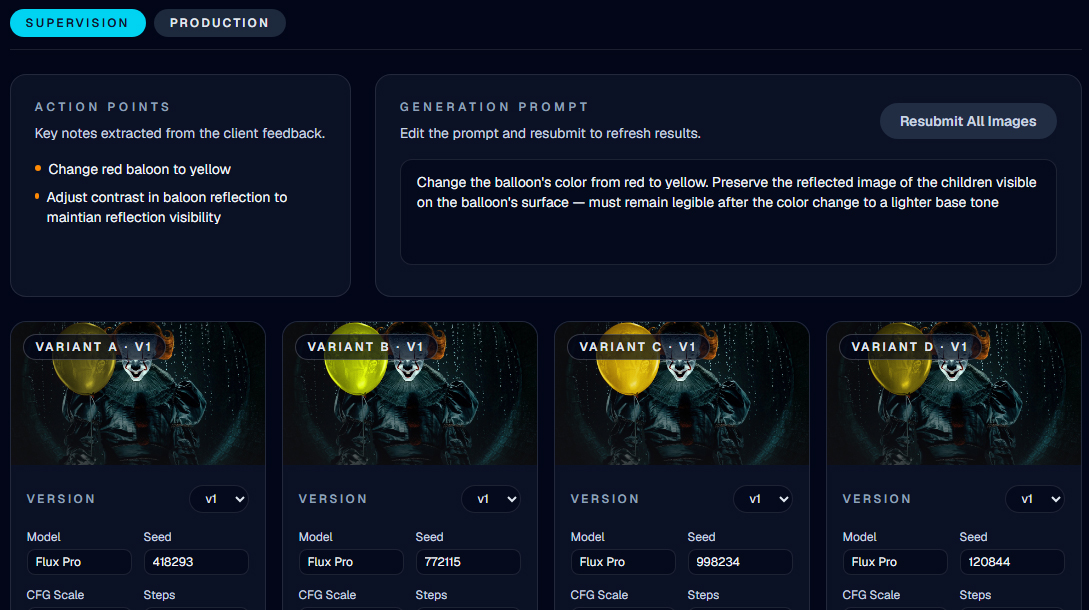
The diffusion model renders the edit inside the mask only — the rest of the frame stays untouched.
When a note spans multiple frames, ControlNet keeps the result consistent across all of them.
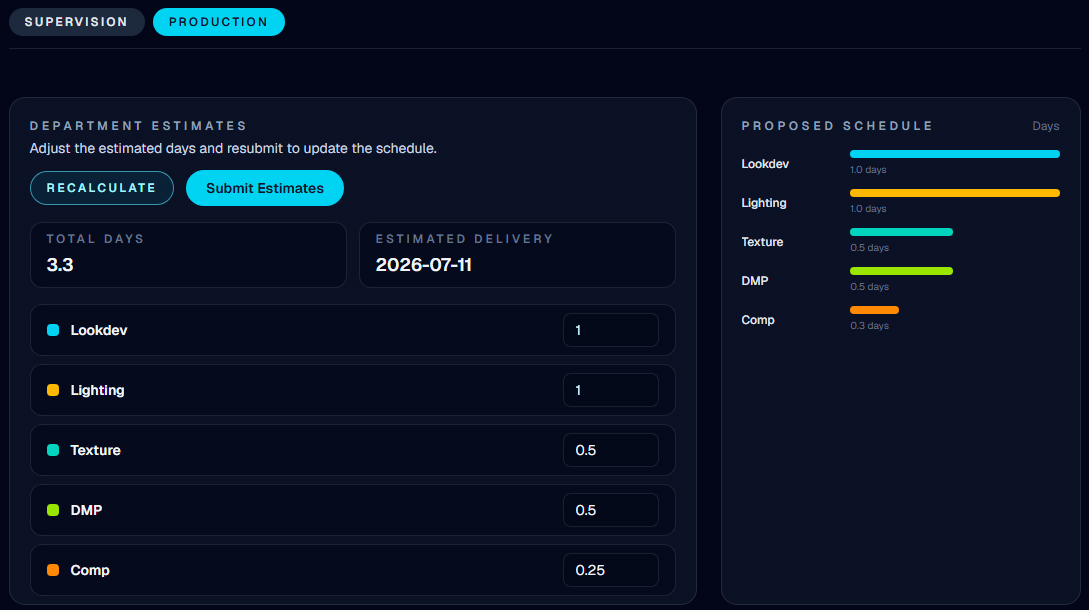
Trained on the studio's own historical data, Bridge identifies the departments involved and estimates the time required for each — giving production a working number immediately.
Once approved by a supervisor, the visual brief and time estimate are published back to the note — ready to brief artists, and feeding Flow's generative scheduling tools directly.
What it changes
Confirm direction in seconds
Instead of writing briefs from scratch, supervisors review a proposed visual answer on the actual frame — approve, tweak the prompt, or reject. Notes stop piling up.
Never blocked on a brief
A picture on the real plate beats a paragraph of interpretation. Artists start with visual intent already confirmed by the supervisor.
A working number, instantly
Department time estimates surface the moment a note is processed — production can plan while the supervisor's own estimate is still pending.
Nothing lost in translation
Client intent is captured, structured and versioned at the moment it lands — not reconstructed from memory three days later.